
The Future of Steel: 5 Game-Changing Updates in the AISC 360-27 Draft
Structural steel design has long been characterized by a “set-in-stone” reputation. While other engineering disciplines have navigated decades of digital upheaval, the fundamental physics of the steel beam remained a dependable, if static, constant. However, the release of the AISC 360-27 Public Review Draft (dated February 7, 2025) represents a technological re-baselining for our industry. This is not a routine clerical update; it is a significant evolution that integrates advanced manufacturing, addresses modern industrial extremes, and introduces a more sophisticated approach to structural safety.
As we look toward the 2027 cycle, these five updates stand as the catalysts that will redefine the boundaries of steel construction.
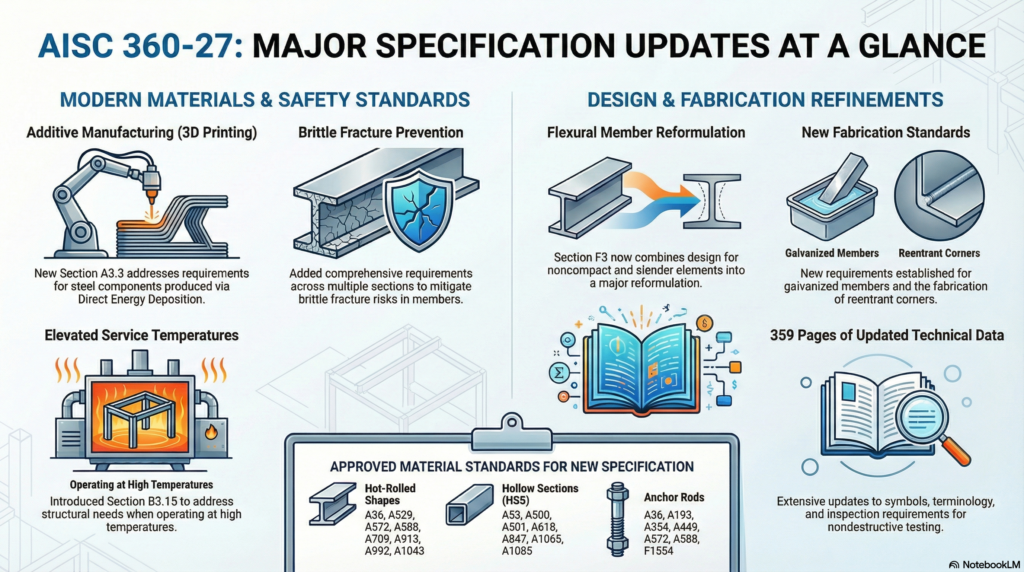
1. Steel 2.0: Embracing Additive Manufacturing (3D Printing)
The most transformative addition to the Specification is found in Section A3.3, which officially codifies “additively manufactured steel components.” This shift moves the industry away from the limitations of traditional casting and rolling toward bespoke, high-tech fabrication using Direct Energy Deposition with Wire Feedstock (DED-Wire).
By requiring qualification according to ASME Section IX Article VI, the Specification ensures that 3D-printed steel meets the same rigorous standards as traditional pressure vessel and nuclear fabrication. This standardization effectively de-risks the additive process, allowing engineers to leverage optimized, organic geometries that were previously impossible to fabricate. To ensure material integrity, the draft mandates a rigorous verification protocol:
“A witness specimen shall be produced with each additively manufactured component. The witness specimen shall be an extension of the component, or a separate piece produced immediately before, immediately after, or concurrent with the component… The witness specimen shall be destructively tested and shown to conform to the requirements of the corresponding material.” (Section A3.3)
2. Beyond Fire: Designing for Elevated Service Temperatures
Traditionally, thermal design was bifurcated: one designed for ambient conditions or for catastrophic “fire events.” Section B3.15 closes a critical gap by addressing “elevated service temperatures”—conditions where normal operations exceed typical ambient limits but do not reach fire-level intensities.
This update is a strategic necessity for high-load industrial sectors, such as data centers with significant heat rejection, petrochemical facilities, or solar thermal plants. In these environments, prolonged heat can impair structural strength or serviceability without ever triggering a fire alarm. The new mandate is unequivocal:
“When elevated service temperatures could impair the strength or serviceability of a structure, structural components shall be designed for the effects of elevated temperatures.” (Section B3.15)
3. A New Defense Against Brittle Fracture: Strain Sensitive Details
In a major move toward enhanced structural safety, the draft introduces the concept of “Strain Sensitive Details” (Section B3.14). This update identifies specific connection configurations at high risk for brittle fracture due to triaxial stress and high weld restraint.
A connection is classified as a Strain Sensitive Detail if it meets these four expert criteria:
- Primary Tensile Forces: Elements are subjected to computed tensile forces from tension or flexure.
- Significant thickness: Two or more elements in the connection exceed 2 in. (50 mm) in thickness.
- High Restraint: Elements are joined by CJP groove welds on orthogonal or nearly orthogonal planes.
- Abrupt Interruption: There is a notch-like condition, access hole, cope, or discontinuous member between the welds.
Critically, Section A3.1f introduces a rigorous material testing requirement for these details. Plate material must be supplied with Charpy V-notch (CVN) impact test results showing a minimum average value of 20 ft-lbf at +70°F, with specimens taken specifically from the centerline of the plate thickness. This ensures that the core of thick plates possesses the necessary toughness to resist fracture in highly restrained environments.
4. Standardizing the Everyday: Galvanizing and Reentrant Corners
The 360-27 draft moves us away from shop-floor “tribal knowledge” toward codified reliability in fabrication. New requirements in Sections M2.11 and M2.12 provide explicit mandates for galvanized members and reentrant corners—cuts made at abrupt changes in direction where the exposed surface is concave (per the Glossary). Standardizing these “concave” geometries is essential for preventing crack initiation at points of high stress concentration.
Furthermore, the Specification now provides a definitive baseline for thermal corrections in the shop:
Section M2.1 includes a new, mandatory table for temperature limits for heating used to introduce or correct camber, curvature, and straightness.
These explicit limits ensure that fabrication techniques do not inadvertently degrade the material properties of the steel, providing a consistent quality baseline for exposed and galvanized structural steel.
5. Breathing New Life into Old Steel: Expanded Appendix 5
As sustainability and adaptive reuse become central to project delivery, the expansion of Appendix 5 (Existing Structures) is perhaps the most practical update for the modern consultant. The scope has shifted significantly from simple “Condition Assessment” to the “alteration of steel structures.”
This expansion provides a standardized framework for the technical and legal challenges of retrofitting aging infrastructure. Key updates include:
- Condition Assessment Protocols: Standardized methods for evaluating existing members.
- Default Material Properties: A critical solution for projects where original mill reports are lost, allowing engineers to establish safe design baselines for historic steel.
- Alteration Requirements: Codified procedures for reinforcing and modifying existing systems to meet modern code requirements.
Conclusion: The Road to 2027
The AISC 360-27 draft represents a move toward precision, technological integration, and safety in extreme environments. By codifying additive manufacturing and providing a clear defense against brittle fracture, the Specification is evolving to match the sophistication of 21st-century engineering.
As 3D printing and advanced thermal modeling move from the fringes to the center of the AISC Specification, how will your next project leverage these new boundaries of steel design?