
5 Critical Shifts in India’s New Seismic Code (IS1893:2025)
Introduction:
The arrival of IS1893:2025 is not merely an incremental update; it is a fundamental paradigm shift for Indian structural engineering. For years, the industry has relied on established defaults in ETABS, but the “new rules of the game” demand a much more rigorous approach to modeling. This evolution towards precision is a necessary response to the increasing complexity of our urban landscape. As designers and technical strategists, we must move beyond checking boxes and fundamentally rethink our modeling philosophy to ensure structural resilience in an era of heightened seismic accountability.
Takeaway 1: The Death of the “Default” Static Analysis (The 80% Rule & Ritz Convergence)
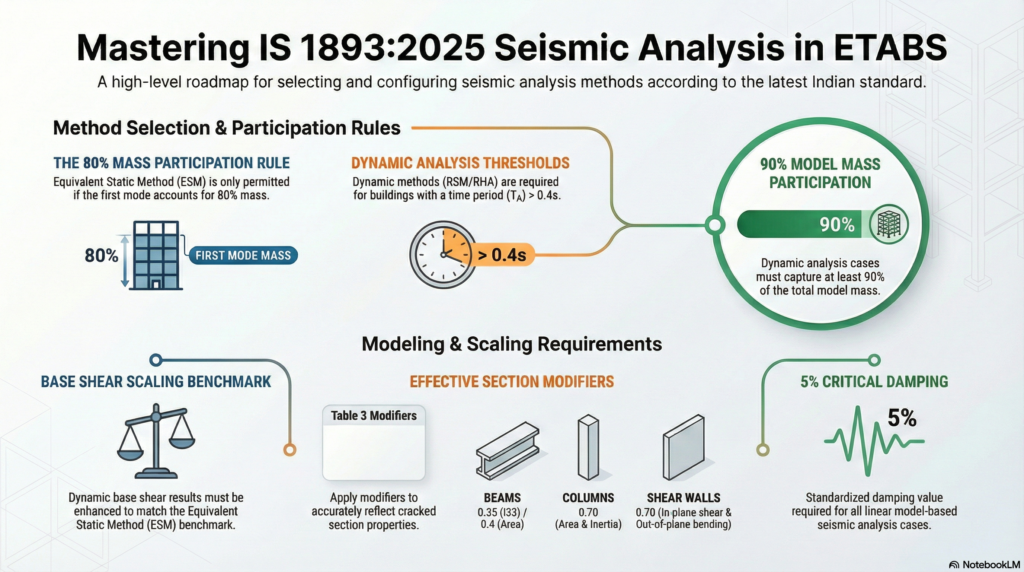
The Equivalent Static Method (ESM) has long been the industry’s “comfort zone,” but IS1893:2025 significantly narrows its application. Per Table 9, Part 5, ESM is only permissible if the structure’s first translational mode accounts for at least 80% of the total mass participation.
This is a high bar. Modern structures—characterized by irregularities or high-rise profiles—rarely concentrate 80% of their mass in a single mode. Furthermore, the code now explicitly recommends dynamic analysis based on the building’s time period. As noted by CSI India experts:
“Taking the natural approximate period T_a calculated using the formula given in the code… if it is greater than [0.4 seconds] then dynamic analysis are applicable and are recommended.”
The Strategic Shift: To satisfy these increased requirements for mass participation (particularly for vertical excitation), engineers should pivot from Eigen Vectors to Ritz Vectors. Ritz Vectors converge faster with fewer modes because they are specific to the load vectors of interest (UX, UY, UZ). In the 2025 landscape, relying on Eigen Vectors may lead to inefficiently large models or failure to meet the 80% participation threshold for static analysis.
Takeaway 2: Precision in Stiffness (The New Table 3 Modifiers)
To achieve realistic structural behavior, the 2025 code provides explicit requirements for effective section properties in Table 3. This standardizes the “cracked” stiffness values that were previously subject to engineering judgment, ensuring consistency across different software implementations.
For concrete buildings, the following modifiers are now mandatory:
Beams: 0.35 (I33 moment of inertia).
Columns: 0.70 (Area and I22/I33 inertia).
Walls: 0.70 (Both area and inertia).
ETABS Implementation: A technical strategist must ensure that wall modifiers are applied precisely within the shell stiffness settings. Specifically, set F11, F22, and M22 to 0.7 (covering axial and out-of-plane bending) and F12 to 0.7 to account for the new requirement to explicitly include effective shear area in the stiffness matrices.
Takeaway 3: Data Intensity (30 to 60 Ground Motions for Response History)
We are entering an era of “data explosion” in seismic design. For critical and special categories, the Response History Method is becoming the expected standard, requiring a massive increase in computational data. The code shifts away from using a handful of records to a robust statistical set:
Far-Field Records (Zones 2-4): 30 ground motion records are required.
Near-Field Records: The requirement doubles to 60 ground motion records.
The Workflow Impact: While the Bureau of Indian Standards (BIS) intends to provide these motions, firms must prepare for the computing overhead required to process 60-record suites. Notably, the BIS-supplied motions are expected to be pre-scaled for the Seismic Zone (Z). This simplifies the workflow, as engineers will primarily need to adjust scale factors to account for the Response Reduction Factor (R).
Takeaway 4: The 1.8 Torsional Factor (The Accidental Eccentricity Override)
One of the most critical “surprises” for engineers is the update to the torsional eccentricity factor. Previous iterations effectively used a factor of 1.5. IS1893:2025 increases this factor to 1.8—a 20% increase that significantly impacts diaphragm and vertical element design.
The Software Gap: Current ETABS implementations for IS1893:2016 are hardcoded with the 1.5 factor. To remain compliant, designers cannot rely on the software’s “default” seismic load patterns. You must calculate the eccentricity manually and use the “User Defined” eccentricity overrides to input the 1.8 factor. Failing to perform this manual override is no longer just a modeling oversight; it is a non-compliance with the 2025 safety standards.
Takeaway 5: Stability Indices and the P-Delta “Health Check”
The 2025 code introduces the stability index ‘Q’ as a diagnostic tool for second-order effects. With a threshold of 0.04, any building exceeding this value requires a linear P-Delta analysis.
Expert Synthesis: In ETABS, this index can be monitored via the K-factors found in the concrete frame design summary. If the frame is identified as a “Sway” frame (where K > 1), the Q factor becomes a critical check. However, the best practice from a technical strategist’s perspective remains unchanged: always perform a P-Delta analysis.
To capture these effects accurately, engineers should convert their design load combinations into nonlinear static cases. This ensures that iterative loads and geometric nonlinearities are captured properly, providing a more robust “health check” than the minimum code threshold requires.
Conclusion: Are Your Workflows Future-Proof?
The IS1893:2025 code represents a fundamental maturation of Indian structural standards. It demands higher precision in stiffness modeling, greater data density in analysis, and a more manual, rigorous approach to torsional effects.
As we transition, firms must immediately audit their “EDB” project templates. Are your property modifiers updated to the Table 3 specifics? Are your seismic load patterns still defaulting to an obsolete 1.5 eccentricity? Most importantly, are your teams equipped to handle the computational demands of 60-record response history analysis? The 2025 code is here; the question is whether your manual workflows and software plugins are prepared for the rigor it demands.