
Executive Summary
The preliminary draft of the fifth revision of IS 456-2025, “Structural Concrete – Code of Practice,” represents a significant evolution in Indian engineering standards. Moving beyond its predecessor, which focused on plain and reinforced concrete, this revision now encompasses prestressed concrete, effectively superseding IS 1343:2012.
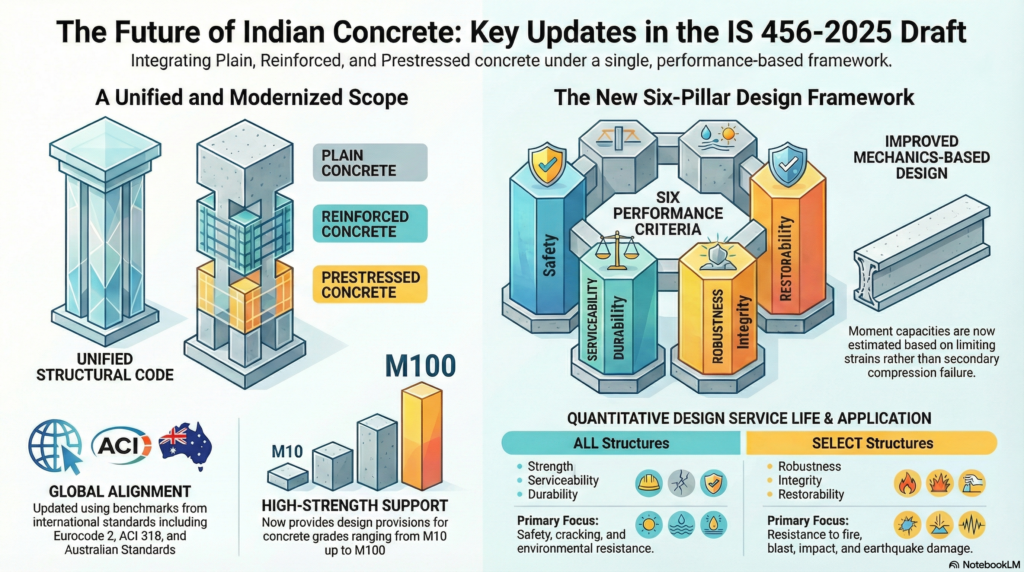
The most critical takeaway is the shift toward a multi-criteria design philosophy. Structures must now be evaluated against six distinct criteria: Strength (Safety), Serviceability, Durability, Robustness, Integrity, and Restorability. This revision introduces a quantitative approach to design service life and incorporates high-strength materials, advances in concrete technology, and an improved understanding of structural mechanics. Notably, the code now explicitly utilizes partial safety factors for materials (\gamma_M) in design strength expressions and mandates a Design Basis Report (DBR) to establish project-specific parameters before design commences.
1. Scope and System Integration
The standard applies to the design, construction, maintenance, and assessment of plain, reinforced, and prestressed concrete structures, including the concrete portions of steel-concrete composite systems.
1.1 Structural Systems Covered
- Plain Concrete: Structures where reinforcement is ignored in strength determination.
- Reinforced Concrete (RC): Includes buildings, liquid retaining structures, bridges, silos, and tunnels.
- Prestressed Concrete (PSC): Covers both pre-tensioned and post-tensioned (internal or external) systems.
- Precast and Composite Systems: Provisions apply to individual components and concrete components, respectively, rather than the global design of the entire composite structure.
1.2 Administrative Requirements
A Design Basis Report (DBR) is now a prerequisite. Authored by the owner in consultation with the designer, it must declare design standards, site investigations, materials, loads, and methods of analysis/design before the project begins.
2. The Six Criteria for Structural Design
The revision mandates that all structures meet Strength, Serviceability, and Durability criteria. Select structures (determined by authorities/owners) must also satisfy Robustness, Integrity, and Restorability.
2.1 Strength (Safety) Criteria
- Performance: Sufficient strength to sustain limited/no damage under basic loads and avoid collapse under extreme load combinations.
- Requirements: Limiting strains in concrete and steel at critical cross-sections define capacity. Strength of members is estimated via the Limit State Method.
2.2 Serviceability Criteria
- Performance: Structures must maintain stiffness to restrict stresses, prevent significant cracking under fatigue, and ensure deformations do not damage utilities or architectural elements.
- Quantitative Limits: Defines permissible crack widths and deformation limits (deflections, rotations, and vibrations).
2.3 Durability Criteria
- Performance: Ability to sustain environmental deterioration (physical, chemical, biological) over the intended design life.
- Design Controls: Mandates specific concrete grades, cement types, maximum free water-cement ratios, and nominal cover to reinforcement.
2.4 Robustness Criteria
- Performance: Resistance to local or global collapse under accidental loads (fire, blast, impact).
- Design Controls: Includes heat transmission limits, blast resistance per IS 4991/IS 6922, and progressive collapse requirements.
2.5 Integrity Criteria
- Performance: Ensuring redundancy and alternate load paths.
- Categorization: Performance varies by structure type (Normal, Important, Critical, Special) as defined in IS 1893 (Part 1).
2.6 Restorability Criteria
- Performance: Ability to return a damaged structure to its original condition through repair or retrofitting.
- Design Controls: Requires accessible locations for potential damage and a predetermined maintenance schedule.
3. Structural Analysis and Load Combinations
3.1 Admissible Analysis Methods
- Linear Static Analysis: Admissible for three-dimensional structures and regular structural grids.
- Dynamic Analysis: Required for vibratory loads or when inertia forces are significant.
- Nonlinear Dynamic Analysis: Used for robustness and integrity checks in select structures, considering both material and geometric nonlinearities.
3.2 Load Types
The code distinguishes between Force Loads (Dead, Imposed, Snow, Wind, etc.) and Deformation Loads (Creep, Shrinkage, Elastic Shortening, Thermal, and Earthquake Shaking).
Table: Unit Weight of Concrete | Concrete Aggregate Type | Unit Weight (kN/m³) | | :— | :— | | Light weight | 10 | | Medium weight | 16 | | Normal weight | 24 | | Heavy weight | 30 | | Very Heavy weight | 36 |
3.3 Partial Safety Factors (\gamma_L)
Design Loads (L_D) are calculated as \gamma_L \times CL (Characteristic Load). The code provides specific \gamma_L values for three sets of combinations:
- Set 1: Basic Combinations (Strength and Serviceability).
- Set 2: Accidental Combinations (Robustness).
- Set 3: Extreme Combinations (Integrity and Restorability).
4. Materials: Concrete, Steel, and Prestressing
4.1 Concrete Properties
- Grades: Categorized into Ordinary (M10-M20), Standard (M25-M60), and High Strength (M65-M100).
- Modulus of Elasticity (E_{ck}): Calculated as 10000 f_{ck}^{0.3} (MPa).
- Creep and Shrinkage: The code provides three levels of creep assessment based on structure type and design life, with specific coefficients for different relative humidities and member sizes.
4.2 Reinforcing Steel
- Permitted Grades: Fe 250, Fe 415, Fe 500, and Fe 550 (conforming to IS 1786).
- Acceptance Criteria:
- Actual yield strength must not exceed 1.2 times the characteristic yield strength (f_y).
- Ratio of actual ultimate tensile strength to actual yield strength must be between 1.15 and 1.25.
- Restrictions: No welding of reinforcement; epoxy coatings or other material coatings are prohibited.
4.3 Prestressing Materials
- Tendons: Can be wires (IS 1785/6003), strands (IS 6006/14268), or high-tensile bars (IS 2090).
- Sheathing: Can be Mild Steel (minimum thickness 0.3-0.5mm) or HDPE (minimum wall thickness 2.0-4.0mm). HDPE must have >2% carbon black for UV resistance.
- Grout: Must be a homogenous mixture of cement and water with a water-cement ratio \le 0.45. Admixtures must not contain chlorides, nitrates, or sulphides. The code mandates specific efflux times and bleed water volume limits (0% in many tests).
5. Quality Assurance and Maintenance
5.1 Quality Control (QC) and Assurance (QA)
- QC: Formal procedures exercised by the construction agency.
- QA: Independent, third-party monitoring to ensure design intent is realized.
- Testing: Compressive strength tests must reach a target mean strength based on standard deviations (ranging from 3.5 to 8.0 MPa depending on the grade).
5.2 Maintenance and Repair
The designer must identify necessary maintenance actions during the design service life.
- Repair: Local material replacement to restore functionality without enhancing stiffness or strength.
- Retrofit: Restoration or enhancement of stiffness, strength, and deformability.
6. Significant Technical Shifts
- Prestressed Concrete Integration: IS 1343:2012 will be withdrawn upon publication of this standard.
- Strain-Based Design: For the limit state of safety, the definition of design strength under flexure is revised from “secondary compression failure” to “reaching limiting strains.”
- Material Safety Factors: All design strength values for concrete and steel are now presented as expressions explicitly showing the partial safety factor \gamma_M.
- Inelasticity in PSC: The code explicitly states that “No inelasticity shall be permitted in prestressed members” during design.