
The Master’s Roadmap to American Structural Design: A Systems-First Blueprint for Global Engineers
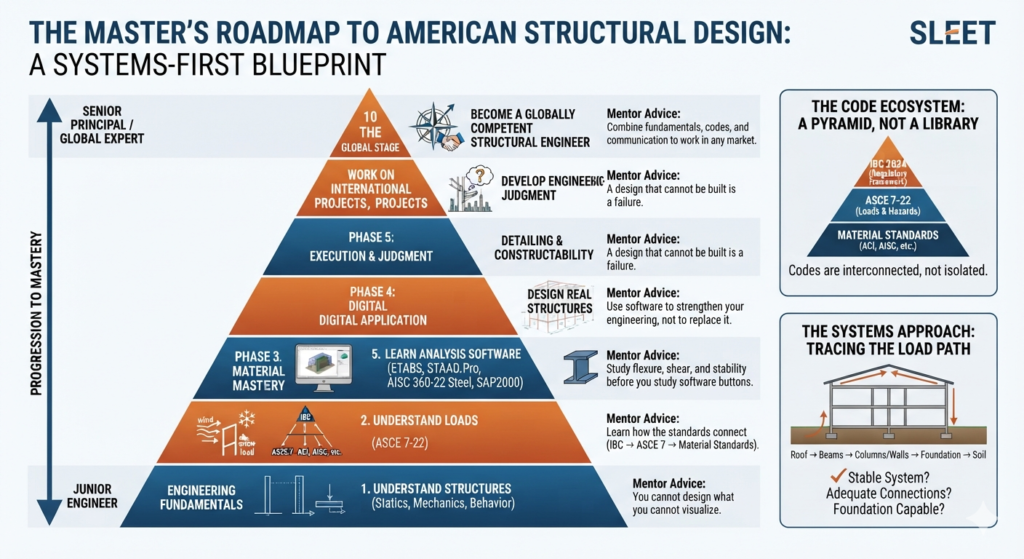
What if mastering American structural design didn’t require memorizing thousands of pages of codes? One of the most significant challenges I see among young engineers is the “Software Trap.” They are experts in the interface of ETABS, STAAD.Pro, or AutoCAD, yet they feel utterly paralyzed when asked: “Which code applies here?” or “Which structural system governs this project?”
In my experience as a mentor, the problem isn’t a lack of technical ability—it is a lack of a structured engineering roadmap. True mastery isn’t about knowing where to click; it’s about understanding the interconnected ecosystem of rules that govern the physical world.
1. The Code Ecosystem is a Pyramid, Not a Library
A common—and dangerous—mistake is treating the International Building Code (IBC), ASCE 7, and material standards like ACI or AISC as isolated books. You must view them as a hierarchical pyramid.
IBC 2024: The Regulatory Framework
At the peak sits the IBC 2024. You must understand that the IBC is not a design manual for concrete or steel. It is a regulatory framework that points you to specialized standards. It coordinates everything from occupancy and fire protection to foundations and special inspections.
The Authority Having Jurisdiction (AHJ)
A senior engineer’s first step is never to grab the latest book; it is to identify the Authority Having Jurisdiction (AHJ). You must verify the project location and which specific code editions have been adopted. Never assume the “latest” code is the “governing” code.
“The IBC is not simply ‘the concrete code’ or ‘the steel code.’ It acts as a central part of the building regulatory framework and references specialized standards.”
2. Loads are the Foundation of Reality
If the IBC is the framework, ASCE/SEI 7-22 is the bridge between a building’s purpose and its physical response. This code defines the hazards and loads your structure must resist, including:
- Gravity Loads: Dead, live, snow, rain, and construction loads.
- Environmental/Lateral Loads: Wind, seismic, flood, tsunami, and atmospheric ice.
Engineering “becomes real” when you master Load Combinations. You must determine not just what loads act, but when they act together and whether you are designing for strength or serviceability.
3. Software is Your Calculator, Not Your Brain
In my years of practice, I’ve seen that prioritizing software tutorials over structural mechanics is a career-limiting move. While STAAD.Pro is a powerhouse for industrial structures and ETABS is the gold standard for multi-story buildings, they are merely tools.
“Software is the calculator. Codes provide the rules. Engineering judgment makes the decision.”
Before you model a single node, you must understand beam and column behavior, frame stability, and load transfer. If you cannot verify that a software’s output makes “engineering sense” based on statics and strength of materials, you are not designing—you are guessing.
4. The “System” Problem: Why Passing Members Can Still Fail
The most dangerous misconception a junior engineer can have is believing that if every member “passes,” the building is safe. Structural engineering is a system problem, not a member-by-member calculation exercise.
To move beyond the junior level, you must be able to trace the Load Path (Roof → Beams → Columns/Walls → Foundation → Soil). If the load path is compromised, the structure is compromised. Use this checklist for every project:
- Is the structural system stable?
- Was the connection adequate to transfer the demand?
- Was the foundation capable of transferring the demand to the ground?
5. Engineering Begins with the “Question”
Consider a 100 m² floor with a service load of 6 kN/m². The math says the total load is 600 kN, and with four supports, the reaction is 150 kN. This is a math problem, not an engineering design.
True engineering begins when you ask: “What assumptions am I making, and are they valid?” You must account for factors that software often hides:
- Tributary Areas: How is the load actually distributed?
- Material Specifics: Navigating ACI 318-19 (Flexure, Shear, and Seismic Detailing) or AISC 360-22 (Stability, Buckling, and Connections).
- Real-World Stressors: Self-weight, lateral wind/seismic effects, and geotechnical soil conditions.
6. The 10-Level Roadmap to Global Competence
An international career requires a progression through these specific phases. Skipping a step is the fastest way to a structural failure.
Phase 1: Engineering Fundamentals
- Level 1: Understand Structures. (Statics, mechanics, and behavior).
- Mentor Advice: You cannot design what you cannot visualize.
Phase 2: The American Ecosystem & Loads
- Level 2: Understand Loads (ASCE 7-22).
- Level 3: Understand Codes (IBC).
- Mentor Advice: Learn how the standards connect (IBC → ASCE 7 → Material Standards).
Phase 3: Material Mastery
- Level 4: Understand Materials (ACI 318-19 / AISC 360-22).
- Mentor Advice: You must study flexure, shear, and stability before you study software buttons.
Phase 4: Digital Application
- Level 5: Learn Analysis Software (ETABS, STAAD.Pro, SAP2000).
- Level 6: Design Real Structures.
- Mentor Advice: Use software to strengthen your engineering, not to replace it.
Phase 5: Execution & Judgment
- Level 7: Detailing & Constructability.
- Level 8: Develop Engineering Judgment.
- Mentor Advice: A design that cannot be built is a failure.
Phase 6: The Global Stage
- Level 9: Work on International Projects.
- Level 10: Become a Globally Competent Structural Engineer.
- Mentor Advice: Combine fundamentals, codes, and communication to work in any market—from the US to the UAE.
Conclusion: Changing the Way You Think
Structural codes are not just a set of rules; they are a way of thinking. They provide the criteria, but you provide the design. By shifting your focus from “button-clicking” to a systems-oriented understanding of the IBC, ASCE 7, and material standards, you build a career that is transferable to any major project worldwide.
Where do you currently stand on this 10-level journey, and which part of the code ecosystem do you find most challenging to navigate?